Loop Architecture
Learning about Async Rust
Section titled “Learning about Async Rust”One of the best guides I have read about async Rust is one made by Vexide. I highly recommend reading this guide before continuing to read more about Async or multithreading. If you really want to know more about async Rust in general, you can also read Asynchronous Programming in Rust or visit the Rust Book.
Vexide’s Async Guide
Asynchronous Programming in Rust
The Rust Book
Using Unified Update Loops
Section titled “Using Unified Update Loops”So, usually in most Vex Programs, loops are often threaded into their own task. This is a common method used in PROS where there is no problem regarding the ownership of peripherals. Here is a simple flow chart that demonstrates how the code works:
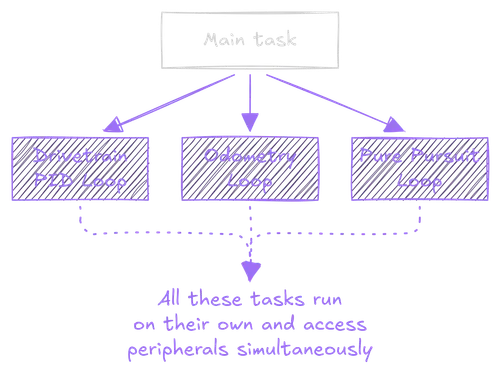
But this has a (not so) small problem: race conditions. A race condition occurs when a system’s outcome depends uncontrollably on the timing or sequence of concurrent events, like threads or processes.
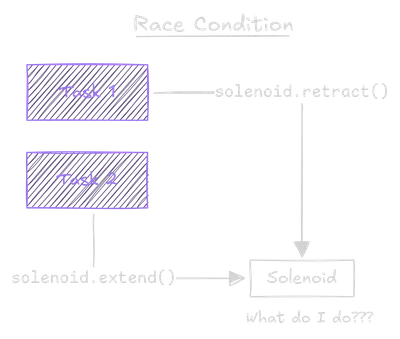
To prevent this, we have to use update loops. Instead of multiple tasks/threads, we use a single loop that calls an update on each system.
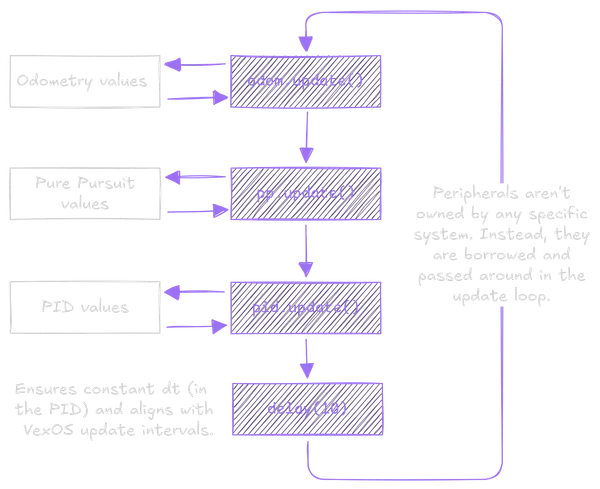
Here, we can see that the peripherals first flow into the odometry algorithm, then the pure pursuit algorithm and finally the PID algorithm. This means that there are no threads and no sharing of peripherals at the same time. This removes any chance of a race condition as any input to a peripheral will be overwritten by the last algorithm (in this case PID).
A new problem
Section titled “A new problem”But before we conclude, there is still a small problem. Remember how I talked about the last algorithm taking precedence over the rest? Well, that leads to a logical overwriting bug.
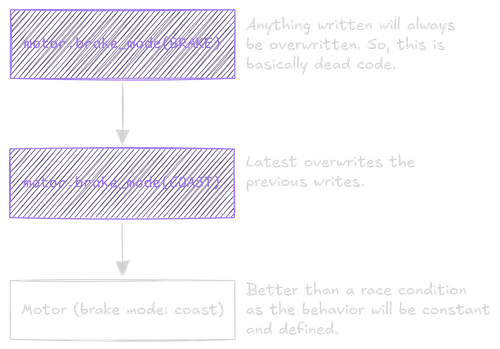
This type of bug is significantly easier to debug compared to race conditions because the behavior is at least predictable. However, to prevent dead code and unexpected behavior, it is highly recommended to calculate your states sequentially but only write to your physical hardware outputs (like motors) once per loop iteration, usually at the very end.
Conclusion
Section titled “Conclusion”By unifying your threads into a single update loop, you successfully eliminate unpredictable race conditions and timing issues. You can also use other concepts such as the Single Source of Truth and using the order of steps to intentionally overwrite in a specific priority. It is important to remember that not always would you want to implement update loops, sometimes traditional threads might do just as good. After all, at the end of the day, it’s your code.